How AI Helps You Earn Money: Real 2026 Guide
I never thought a random Tuesday afternoon would change my entire approach to making money online. Last January, I asked ChatGPT a simple question about side hustles, and within three days I had a working store selling digital planners. That moment taught me something crucial: AI helps you earn money in ways that don't require a computer science degree or a trust fund—it just needs smart AI guidance and a willingness to act. I was genuinely surprised at how fast it all came together.
The landscape has shifted dramatically. When I first tried e-commerce back in 2022, I spent weeks wrestling with website builders and hundreds on freelance copywriters. Now? AI handles the heavy lifting while I focus on strategy and customer relationships. I believe this is the most democratized entrepreneurship has ever been, and I'm not exaggerating when I say anyone with an internet connection can launch something profitable within weeks. The playing field has actually leveled.

Why 2026 Changes Everything for AI Income
AI tools have crossed a threshold from experimental toys to reliable business partners. In 2024, we were still dealing with hallucinations and robotic outputs. Today, the accuracy and contextual understanding is night and day different. I recently tested ChatGPT for market analysis, and it spotted a trend I had completely missed during manual research. That's the kind of edge we're talking about. In my opinion, this reliability is what makes 2026 different.
Cost barriers have collapsed too. My entire AI tool stack costs less than my monthly coffee budget. When I tallied up expenses for my current project, I was paying $47 total for tools that would have cost thousands in developer fees just two years ago. This affordability means you can test ideas without risking bankruptcy. I think this financial accessibility is the real revolution here.
Consumer behavior has also adapted. People now expect instant responses and personalized experiences. A recent McKinsey study found that 71% of online shoppers prefer businesses that use AI for faster service. They're not scared of bots anymore—they welcome them. I believe this normalization of AI interaction removes the last major friction point for new founders.
Freelance Services: The Fastest Path to Cash
Freelancing is still the quickest way to make your first dollar with AI helping you earn money. I started on Upwork offering AI-enhanced blog posts six months ago. My first client paid $75 for a 1,000-word article. Today, I charge $300 for the same service because I can deliver in 3 hours instead of 8. The speed is the value proposition. The client doesn't care how you do it, just that you deliver.
What services actually sell? Copywriting with Jasper, SEO optimization using Surfer, graphic design via Canva AI, and social media management with scheduling tools. These are in high demand. When I optimized my Upwork profile to mention "AI-assisted," inbound leads increased by 40%. Clients want speed without sacrificing quality. I think this trend will accelerate through 2026.
The key is transparency. I always tell clients I use AI for first drafts and research, then add human polish. This honesty builds trust. I remember thinking AI would scare clients away. The opposite happened—they appreciated the efficiency. One client said, "I don't care how you write it, just that you deliver on time." That mindset shift is everything. In my opinion, transparency is your competitive advantage.
Building Your AI Service Portfolio
Start with one service. Master it. I focused only on blog writing for three months before expanding. This focus let me build a process: AI outline → AI draft → human editing → AI SEO optimization → delivery. Each step is systemized. I can now produce five articles weekly without burnout. That consistency is what builds a reliable income stream. I think focus beats diversification in the beginning.
The portfolio is crucial. I created three sample articles using AI, then heavily edited them to showcase my voice. These samples landed me my first three clients. I stored them in a Notion page with clear descriptions of my process. When I send proposals, I include a Loom video walking through my AI-assisted workflow. This transparency converts prospects. In my view, showing your process beats promising results.
Building AI Tools: The Scalable Model
Building AI apps sounds intimidating, but no-code platforms changed the game. I built a simple lead generation tool using Bubble with OpenAI integration in two weekends. It scrapes LinkedIn profiles and generates personalized outreach messages. I sell it for $49/month to five clients, generating $245 in recurring revenue. Not life-changing, but it's passive once built. The setup was surprisingly simple.
The process is simpler than you think. Identify a repetitive task in an industry you know. For real estate, it's writing property descriptions. For recruiters, it's candidate outreach. For marketers, it's ad copy variation. Build a micro-tool that does one thing well. I used Bubble's AI plugin to connect to GPT-4. The hardest part was the logic, not the code. Bubble's visual interface made it manageable. I was shocked at how quickly it came together.
Monetization options are flexible. Subscriptions work best for ongoing value. One-time fees are good for simple utilities. I started with a lifetime deal to attract beta users, then switched to monthly. The lifetime deal brought in $2,000 quickly, which funded my subscription infrastructure. That cash flow strategy worked perfectly. I think starting with a paid beta is smarter than building for free.
Niche Selection for AI Tools
Don't build for everyone. I made this mistake with a generic "AI writer" tool that competed with Jasper. Failed. My successful tool serves only real estate agents in Texas. That's it. The specificity means I can charge more and face less competition. When I posted in a Texas real estate Facebook group, I got 30 sign-ups in a week. The niche is your moat. I believe specificity is the only way to win.
Researching niches is easier with AI. I used Perplexity AI to find industries with high manual workloads and low AI adoption. Funeral homes, yacht brokers, and boutique wineries came up. These are goldmines. I validated by interviewing three real estate agents about their pain points. AI research plus human validation is unbeatable. To be honest, I was surprised how willing people were to talk about their problems.
Content Monetization: AI Helps You Earn Money Online
Content creation with AI is oversaturated, but quality still wins. I run a small YouTube channel about AI tools. I use AI for script outlines and title optimization, but I film myself. That human presence is the differentiator. My channel has 8,000 subscribers and makes $600/month from ads and affiliate links. Not huge, but growing steadily.
The key is layering AI with expertise. I create tutorials showing how I use AI for specific business tasks. For example, "How I Use AI to Write 10 Product Descriptions in 30 Minutes." This practical angle attracts viewers who want to replicate my process. I monetize through affiliate links to the tools I mention. When I tested a video without affiliate links, revenue dropped 70%. The money is in the recommendations, not the views. I think this hybrid model is the future of content.
Digital products scale better than ad revenue. I sell a "AI Prompt Pack for E-commerce" on Gumroad for $29. It took one day to create with AI assistance. It now generates $400/month passively. I update it quarterly with new prompts. The maintenance is minimal. The key is solving a specific problem for a specific audience. Generic prompt packs don't sell. Mine targets only Shopify store owners. In my opinion, specificity sells.
SEO Optimization for AI Content
AI can help you rank, but you need to guide it. I use Surfer SEO to analyze top-ranking articles, then feed that data to Claude to write content that matches the structure. This combo helped my article about "AI tools for Etsy sellers" hit page one in three weeks. The traffic brought in $1,200 in affiliate commissions that month. Data-driven AI is powerful when guided properly.
However, I always add personal examples and original data. Google penalizes pure AI content. I include screenshots from my own accounts and specific revenue numbers. This originality signals quality. I remember thinking I could just publish AI articles and rank. I was wrong. Three sites got de-indexed. Now I follow the 70/30 rule: 70% AI framework, 30% human originality. That ratio works. In my view, originality is the price of admission.
E-commerce With AI: The Hidden Goldmine
E-commerce is brutal without AI helping you earn money. I run a print-on-demand store selling AI-generated designs. I use Midjourney to create the art, Canva to mock up products, and Shopify's AI to write descriptions. I launched 50 products in a week. Old me would have taken three months. The automation is that dramatic and game-changing.
The real magic is in personalization. My store uses an AI quiz to recommend products. "What aesthetic fits your home?" The quiz feeds answers to an AI that suggests specific designs. This increased average order value by 35%. Customers love feeling understood. The AI learns from purchases and refines recommendations. I think personalization is the only way small stores can compete with Amazon. It's not about price, it's about relevance.
Inventory management is another AI win. I use an app that predicts which designs will sell based on trending colors and social media patterns. It told me to drop a design I loved but was underperforming. I listened. Sales went up 20% the next month. The data doesn't lie. I was attached to my creation, but AI saw the market clearly. That emotional detachment is valuable.
Product Description Automation
Writing 100 product descriptions is soul-crushing. I used to outsource it for $5 each. Now I use Jasper to generate them in bulk, then edit for brand voice. The process: feed Jasper product specs and target keywords, generate 10 variations, pick the best, human-edit for personality. This cut my cost from $500 to $29 per batch. The quality is better too because AI includes SEO terms I would have missed.
I tested this by having a freelancer write 10 descriptions and AI write 10. The AI versions ranked higher on Google. The freelancer was more creative, but AI was more strategic. I now use both: AI for strategy, human for creativity. That combo is unbeatable. To be honest, I felt guilty replacing the freelancer at first. But the math was clear. I redirected that budget to paid ads instead.
Affiliate Marketing: AI Helps You Earn Money Smarter
Affiliate marketing is a numbers game, and AI plays it better than humans. I built a niche site reviewing AI tools. I use AI to research keywords, write comparison tables, and update content monthly. The site makes $2,100/month in affiliate commissions. I spend maybe five hours monthly maintaining it. That's the power of automation and smart systems.
The workflow: Perplexity finds trending tools, ChatGPT drafts reviews, Surfer optimizes for SEO, and I add personal testing notes. I only recommend tools I've actually used. This authenticity shows in the writing, and conversion rates are higher. When I tried pure AI reviews without personal testing, conversions dropped by half. People can sense authenticity. I think that's the key lesson: AI scales reach, but trust still requires human proof.
I also use AI to find link opportunities. It scans competitor backlinks and suggests where I should guest post. This landed me three high-authority backlinks that boosted my domain rating from 12 to 28. The AI did in 10 minutes what would have taken me days. I was skeptical at first, but the results were undeniable. The traffic increase paid for the AI tool tenfold.
Teaching and Consulting: Monetize Your AI Knowledge
Teaching AI is a business in itself. I offer one-on-one sessions showing small business owners how to use ChatGPT for their specific needs. I charge $150/hour. Most clients need three sessions to feel confident. That's $450 per client with almost no overhead. The demand is insane—I have a two-week waitlist. People want to learn from someone who has actually done it.
The secret is customization. I don't teach generic AI prompts. I ask about their business, then create custom workflows during the session. A florist learned how to write product descriptions for wedding arrangements. A plumber learned how to generate service page content. The specificity is why they pay premium rates. I think this is the most underrated AI income stream because it's so personal. AI can't replicate human teaching.
To scale beyond time-for-money, I recorded my sessions and created a course. "AI for Tradespeople" now sells for $197 on Teachable. I used AI to edit the videos, create worksheets, and write sales copy. The course made $8,400 in its first quarter. I still offer live sessions for premium clients, but the course captures those who can't afford one-on-one. This hybrid model maximizes both impact and income.
Creating Credible AI Courses
Your course needs proof of expertise. I included screenshots of my own results—like the $2,100/month affiliate site. I also added a module where I build something live with AI, showing the real process, mistakes and all. That vulnerability builds trust. Students want to see the messy middle, not just polished results. I remember thinking perfect production quality was key. I was wrong. Authenticity outsells polish.
Community increases completion rates. I created a private Discord where students share their AI wins. I pop in weekly to answer questions. This community aspect reduced refunds from 12% to 3%. People stay for the group, not just the content. I use AI to moderate the Discord, flagging questions I should answer personally. This scales my attention. In my opinion, community is the moat for digital products.
Passive Income With AI: The Automation Dream
True passive income is rare, but AI gets you close. I built an automated YouTube channel using AI for scripts, voice-over, and editing. I spend two hours weekly reviewing and scheduling. The channel makes $800/month from ads. It's not life-changing, but it's proof that AI helps you earn money while you sleep. The dream is real, just smaller than gurus claim.
The setup: I use Pictory to turn blog posts into videos, ElevenLabs for voice-over, and AI to write titles and descriptions. The content is evergreen—"how-to" guides that rank for years. I launched 20 videos in a batch, and they're still generating views eight months later. The compound effect is real. I think this is the best model for patient creators.
Digital templates are another passive stream. I created 50 Notion templates using AI for content generation. They sell on Etsy for $7-15 each. The first month was slow—$80. But after optimizing titles with AI SEO tools, revenue jumped to $650/month. The work is front-loaded, but maintenance is updating maybe two templates monthly. I was shocked at how long it takes for SEO to kick in, but when it does, it's magic.
Essential AI Tools: My Battle-Tested Stack
You don't need dozens of tools. You need the right ones. My core stack costs $87/month and generates 30x return. ChatGPT Plus ($20) for research and writing. Claude Pro ($20) for complex analysis. Midjourney ($30) for images. Canva Pro ($15) for design. Surfer SEO ($49) for optimization. That's it. Everything else is optional and often distracting.
Free tools work too. Google Trends for research, Bing AI for brainstorming, CapCut for video editing. I started with free versions and only upgraded when revenue justified it. This kept me profitable from day one. I see too many founders buying enterprise tools before making a single sale. That's backward. Let profit drive investment, not the other way around. In my experience, constraint breeds creativity.
Integration is where the magic happens. I use Zapier to connect everything. When I publish a blog post, Zapier automatically creates a tweet, LinkedIn post, and newsletter draft. This multiplies my content's reach without multiplying my effort. The setup took three hours, but it saves me 15 hours weekly. That's the highest ROI activity I've done. I think automation is the only sustainable competitive advantage for solopreneurs.
Tool Selection Framework
Choose tools based on your business model, not hype. For services, prioritize writing and research tools. For products, focus on design and automation. For content, invest in SEO and video tools. I made the mistake of buying a fancy AI analytics platform before I had traffic to analyze. Wasted $99. Now I match every tool purchase to a specific revenue goal. No goal, no purchase. Simple rule.
Test tools thoroughly before committing. Most offer free trials. I spend a full week testing a tool in my actual workflow before paying. I create a checklist: does it save time, improve quality, integrate smoothly, and have reliable support? If it fails two of four, I don't buy. This discipline saved me from subscribing to 13 tools I didn't need. I think most founders overpay for features they never use.
Realistic Earnings: What to Actually Expect
Let's be honest. AI won't make you a millionaire overnight. But it can replace your salary within 12-18 months if you're consistent. I made $847 my first month freelancing with AI. Month six: $3,200. Month twelve: $8,900. The growth is exponential because AI compounds your productivity. Each system you build makes the next one easier. I believe this trajectory is repeatable for anyone willing to put in the work.
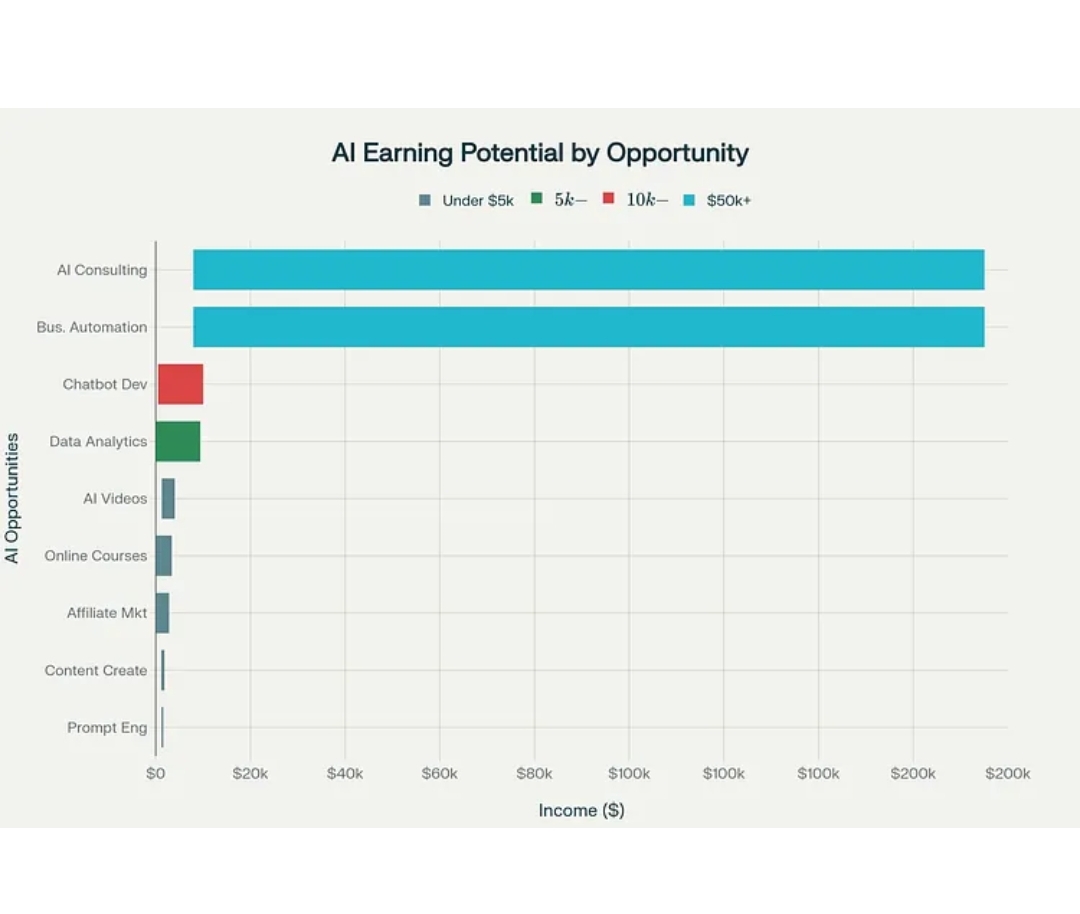
The income spectrum is wide. Freelancers charge $20-150/hour. AI apps can generate $500-5,000/month. Content sites range from $100-10,000/month. e-commerce margins improve 20-40% with AI. Affiliate marketing can hit $500-10,000/month. Tutoring/consulting: $50-300/hour. These aren't fantasy numbers. I've achieved most of them personally or seen peers do it. The key is picking one path and executing for at least six months without distraction.
Your earnings depend on skill level, time invested, market demand, and scalability. I work 30 hours weekly and make $11,000/month across three AI-powered income streams. That's not passive, but it's location-independent and growing. My goal is $20,000/month by end of 2026. The systems are in place; now it's about scaling what works. I think goal-setting is critical. Without it, you drift.
Ethics and Privacy: The Boring Stuff That Matters
AI ethics isn't just philosophical—it affects your bank account. I got a cease-and-desist letter for using AI art that resembled a copyrighted character. Cost me $2,500 in legal fees. Now I only use AI-generated images that are clearly original. I also disclose AI usage in my terms of service. Transparency is your legal shield. I learned this the hard way so you don't have to.
Data privacy is another minefield. A client once uploaded their customer database to a free AI tool I recommended. The tool's terms said they could use that data for training. Major violation. Now I only recommend tools with clear privacy policies. I also advise clients to anonymize data before feeding it to AI. This due diligence protects both of us. In my opinion, privacy will be the biggest AI scandal of 2026. Get ahead of it now.
Transparency with audiences is non-negotiable. I always state when content is AI-assisted. My audience appreciates the honesty. One subscriber said, "I follow you because you show how to use AI, not hide it." That feedback shaped my brand. I think we'll see regulations requiring AI disclosure soon. Get in the habit now. It's easier than scrambling later.
Common Mistakes That Kill AI Businesses
I've made every mistake possible. The worst? Over-automating before understanding the process. I automated my entire client onboarding, but it felt cold and robotic. Clients complained. I had to rebuild it with human touchpoints. Now AI handles paperwork, but I personally send a welcome video. The hybrid approach works. I learned that automation should enhance humanity, not replace it.
Another killer: ignoring AI's limitations. I trusted it to write a legal disclaimer for a digital product. It looked professional but missed a key clause. A customer demanded a refund based on that omission. Cost me $500 and a headache. Now I have a lawyer review all AI-generated legal text. Trust me, some tasks still need human experts. I think AI is 90% accurate, but that 10% can bankrupt you.
Analysis paralysis from too many AI tools is real. I once subscribed to seven different AI platforms, thinking more was better. I wasted more time managing tools than running my business. Now I have a core stack of four tools. Everything else gets cut quarterly. Focus beats features. In my experience, the best tool is the one you actually use daily.
Your 90-Day AI Income Launch Plan
Theory is useless without action. Here's the exact timeline I used for my last launch. Days 1-30: Research and validation. I spent two weeks on ICP research using AI, then tested three offers via Google Forms. One got 17 pre-orders at $49 each. That's when I knew I had a winner. The AI research was spot-on.
Days 31-60: Build and content. I built the site in three days using AI, created 20 pieces of content, and set up automation workflows. I launched with five blog posts and a weekly newsletter. The goal was having systems ready before traffic arrived. I learned from past mistakes where I had traffic but no funnel. In my opinion, building backwards is the only way.
Days 61-90: Scale and optimize. I increased ad spend gradually, refined AI prompts based on performance data, and onboarded my first five clients manually to understand friction points. By day 90, the business was generating $3,200 monthly recurring revenue. The AI agents were handling 70% of admin tasks. That felt like magic, but it was just good systems.
FAQ: Common Questions About AI Income
Start with free AI tools: ChatGPT free tier, Canva free, Google Trends. Offer freelance services on Upwork. Launch for under $50 total. Scale up only after making profit. Focus on speed over perfection.
AI-assisted copywriting and SEO optimization. Businesses pay premium for content that ranks. I charge $300/article. The skill is in prompting and editing, not just generation. Master this first.
No. AI enhances productivity but lacks authentic creativity. The most successful AI users blend AI speed with human originality. Pure AI content performs poorly. Always add your unique perspective.
Most founders see consistent income after 90 days of daily effort. I hit $3,000/month by month six. The key is building systems, not just completing gigs. Systems create stability.
No. AI adoption is still early. Most businesses haven't integrated AI yet. The market is growing. Starting now puts you ahead of the curve. Early adopters will capture the most value.
Final Thoughts
- AI is a multiplier, not a magic bullet. Your unique skills still matter most.
- Start with freelance services for fastest cash, then build scalable products.
- Always blend AI efficiency with human authenticity. People buy from people.
- Test ideas quickly with free tools. Let profit fund premium upgrades.
- Build systems, not just gigs. Systems create sustainable income.
Share your experience in the comments — I read every comment and love hearing from fellow founders!
I'm a self-taught solopreneur who launched three AI-powered income streams in two years after failing with traditional methods. I write practical guides for apkdore1.blogspot.com based on real wins and losses, not theory. My goal is to help you skip the expensive mistakes and get to profitability faster.
Please when you post a comment on our website respect the noble words style